Abdication or Liability: The Two Ways Leaders Get AI Wrong

Why AI strategy can be neither handed to IT nor ordered from the top
The first article in the series ‘AI as a Leadership Responsibility’.
Two sentences that sound like leadership
When AI comes up in the boardroom, two sentences are heard more than any others. The first is ‘IT will bring us a proposal.’ The second is ‘By the summer, every team uses AI.’ Both sound like leadership. The first is abdication, and the second is liability; both fail for the same reason.
The same two failures show up when you renovate a house. One owner tells the builder, ‘You are the expert, do what you think best’, and comes back to find the budget doubled and the garden gone. Another owner, having seen a photograph in a magazine, orders ‘Knock that wall through’ without asking whether it carries the floor above. The owner who gets a good result neither lays bricks nor hands over the keys. They know which walls are load-bearing, keep control of the budget and stay accountable for the house. The AI decisions an organisation faces are its load-bearing walls.
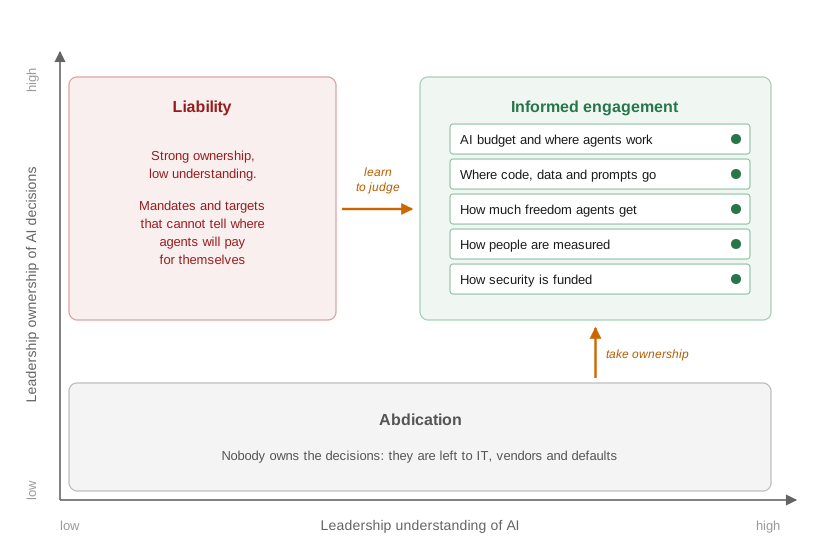
A leader who delegates AI strategy entirely to the technology function has abdicated a structural responsibility. A leader who mandates AI adoption without understanding what AI can and cannot do has imposed a structural liability (Society for Adaptive Organisations, 2026). Both boardroom sentences are the same mistake: they treat AI as a tool decision when it is a structural one. The middle ground is informed engagement. Leaders learn enough to judge, and they make sure that five decisions each have a clear owner, shared by the teams concerned and management, before agents are used at scale: (1) the AI budget and where agents are used at all, (2) where code, data and prompts may go, (3) how much freedom agents get, (4) how people are measured, and (5) how security is funded.
Abdication looks like delegation
Delegating to experts is normally good practice, which is why abdication is hard to spot. You do not tell the accountant how to do your tax return or check the engineer’s structural calculations. The trap is that the questions AI raises are not only technical. They concern money, legal exposure, how people are judged and how work is organised. None of them belongs to the technology function alone.
Analyst forecasts point the same way, although they are best read as positioning rather than proof. Gartner forecasts that more than 40 per cent of agentic AI projects will be cancelled by the end of 2027, citing escalating costs, unclear business value or inadequate risk controls (Gartner, 2025). None of those three is a technology failure, and none of them can be remedied by the technology function on its own.
Samsung is a case study in a decision nobody took. In 2023 an engineer at the company uploaded sensitive internal source code to ChatGPT, and within weeks Samsung banned its employees from using ChatGPT and other AI chatbots (Ray, 2023). The point is not that the engineer was careless. Nobody had decided, in advance, where company code was allowed to go. Whoever happened to use the tool made that decision.
Adaptive Organisations sets out why this cannot be delegated. The structural prerequisites for using agents well, clear accountability for outcomes, decision authority at the point of knowledge, fast feedback loops and a systems perspective, are the same as the prerequisites for adaptivity itself. Organisations that have not built them will find AI agents an expensive amplifier of their existing problems (Society for Adaptive Organisations, 2026). Building them is leadership work, which is why handing AI strategy to the technology function is abdication.
Liability looks like ambition
A mandate with a target, ’every team, by the summer’, sounds like commitment. In practice it ignores the most robust finding about agents, which is that whether agents pay off depends on the work. On SWE-Bench Mobile, a benchmark of 50 tasks taken from a production iOS codebase, the best agent configurations succeeded on only 12 per cent of tasks. Success fell from 18 per cent on tasks touching one or two files to 2 per cent on tasks touching seven files or more (Tian et al., 2026). A blanket order cannot tell a small, well-tested service from a legacy core system, so it deploys agents everywhere at once and then measures only adoption.
Mandates usually rest on a second assumption: that full autonomy is close. Every well-documented agent system keeps human review as a gate, and executives who believe full autonomy is imminent underinvest in what the research shows actually produces value from AI: internal platform quality and developer experience (Pugliese & Zanotto, 2026). A target date does not change what the models can do; it only makes the gap between the mandate and the evidence more conspicuous.
Mandates also amplify what is already in the organisation. The full argument, with the evidence, is in Always Catching Up on AI? It’s Not About the Tools.
The cost of adoption without redesign shows up in the data on pilots. MIT’s Project NANDA reports that 95 per cent of the organisations it studied are getting zero return from generative AI, and that only 5 per cent of integrated pilots extract significant value. The authors present these as preliminary findings (Challapally et al., 2025). They indicate how often adoption without redesign disappoints; they do not prove why.
Five decisions with a name next to them
Take the five decisions in turn.
The AI budget needs an owner, and so does the question of where agents are used at all. Agents are token-hungry by design, and the spend follows the deployment. No credible, independently audited figure for token spend per developer could be found (Pugliese & Zanotto, 2026), so nobody can borrow a benchmark: the organisation has to track the number itself, and it must be clear who does. The budget also has to cover skills. Small and medium-sized enterprises consistently name skill shortages as one of the main hurdles to adoption, and financial constraints hinder the long-term investment it needs (OECD, 2025). Management sets the overall spend. Where agents are deployed is a joint decision: leadership sets the budget and boundary conditions, and teams decide where conditions favour agents, starting with small, well-tested work before moving to large, interdependent systems.
Where code, data and prompts may go is a legal and contractual decision, and it cannot be left to whoever configures the tool. A prompt containing personal data falls under the GDPR and may involve an international transfer (European Union, 2016a). Proprietary code leaving the organisation raises trade-secret questions that turn on whether reasonable steps were taken to keep it secret (European Union, 2016b). In December 2024 the Italian data-protection authority fined OpenAI 15 million euros for, among other things, processing personal data to train ChatGPT without an adequate legal basis and for failures of transparency. In March 2026 the Court of Rome annulled the fine because the Italian authority lacked jurisdiction, without ruling on the substance (Garante per la protezione dei dati personali, 2024). The episode still shows what regulators look at first: the flow of data to external models. Management, together with the legal function and the teams that use the tools, decides where each class of material may go.
Decide how much freedom agents get before they start work, not after something goes wrong. The decision belongs inside the team rather than with a new post above it. Set the freedom by type of work, make clear who is responsible for what the agents do (a team or a group of teams, together with management), and treat the levels as a hypothesis: keep a record of what agents did, and adjust their freedom in the team’s regular reviews.
How people are measured deserves a hard rule: agent data belongs to the people who do the work, for their own reflection, and management must not lead by it. Read upwards, the numbers reward whoever generates work over whoever absorbs it and erode the psychological safety people need to say that the agent was wrong. In the European Union they also change the legal status of the tool: once agent data is used to evaluate workers’ performance, the AI Act treats the system as high-risk, with duties of human oversight and of informing workers and their representatives in advance (European Union, 2024). Leaders who want to know how the work is going have to go and see it.
How security is funded is the decision the others quietly depend on. In a controlled study of 47 participants, those given an AI coding assistant wrote less secure code than those without one on four of five security tasks, yet were more likely to believe their code was secure (Perry et al., 2023). The assistant was based on a 2022 model, so the exact figures may not carry over to today’s tools. Models also invent package names. In a study of 576,000 code samples from 16 models, at least 5.2 per cent of the packages recommended by commercial models, and 21.7 per cent of those recommended by open-source models, did not exist. An attacker can register such a name and fill it with malicious code (Spracklen et al., 2025). A security review at the end of the process catches neither problem. Scanning, approved dependency lists and training are investments only leadership can fund.
It would be wrong to conclude that leadership must make all five decisions. It need not, and teams should not make them in isolation either. Each works best as a shared decision between informed leadership and the people using AI in the field: leadership sets the boundary conditions, and the teams decide how the work is done. Both need to see the problem as a system, and neither may abdicate its part. Agentic Coding Teams points the same way: it reads new roles such as agent orchestrator and AI coach as skills a team needs rather than as standalone posts (Pugliese & Zanotto, 2026). Appointing a chief AI officer or a central governance layer is no substitute for making clear who shares responsibility for each of the five decisions.
Ask who owns it
Now turn the list on your own organisation. If a regulator, a client or a journalist asked tomorrow who in your organisation decided where your source code and customer data may be sent to AI models, could you say who, and would they agree it is theirs? Who owns the AI budget, and are they also allowed to say ’not here’ for a part of the system where agents will not pay for themselves? When did your leadership team last use an AI agent on real work, rather than watch a demonstration of one?
Has your organisation written down, team by team, how much freedom agents have before they are switched on, or will you find out after the first incident? Would anything in your current AI roll-out plan have to change if the target date were removed? And which of the five decisions is made by default today, by a tool setting, a vendor contract or an individual’s habit? If nobody can say who owns a decision, the decision has already been made by whoever configured the tool.
Informed engagement is a learning practice
The middle ground is not a position you reach once and hold. It is the principle of leadership as a continuous learning practice, applied to AI. Leaders must develop their own understanding of AI’s capabilities and limitations, ’not to become technologists, but to exercise the judgment’ that the principle demands (Society for Adaptive Organisations, 2026). As in any unfamiliar domain, understanding is built by doing, watching the work and being corrected. No compliance programme can supply that, which is why the EU AI Act’s AI-literacy obligation is a floor rather than a target. It has applied to providers and deployers of AI systems since 2 February 2025, and the amendments of July 2026 softened it further, from ensuring a sufficient level of literacy to supporting its development (European Union, 2024, 2026). The larger frame for this practice is described in What is adaptive leadership.
For the full argument, read chapter 13 of Adaptive Organisations: Thriving in Complexity, ‘Adaptive Organisations in the Age of Artificial Intelligence’. It explains why the prerequisites for using agents well are the same as those for adaptivity itself, and closes by mapping each AI challenge to the dimensions and principles of adaptivity.
Every AI decision that leadership does not take is still taken, by a default setting, a vendor’s terms or a habit. The question for a board is less whether it has an AI strategy than whether it knows who made the decisions that strategy depends on. The choice is not between leading on AI and leaving it alone. It is between deciding on purpose and discovering later what was decided for you.
Sources
- Challapally, A., Pease, C., Raskar, R., & Chari, P. (2025, July). The GenAI divide: State of AI in business 2025 [Preliminary findings]. MIT NANDA. https://www.media.mit.edu/groups/nanda/overview/
- European Union. (2016a). Regulation (EU) 2016/679 of the European Parliament and of the Council of 27 April 2016 on the protection of natural persons with regard to the processing of personal data and on the free movement of such data (General Data Protection Regulation). Official Journal of the European Union, L 119. http://data.europa.eu/eli/reg/2016/679/oj
- European Union. (2016b). Directive (EU) 2016/943 of the European Parliament and of the Council of 8 June 2016 on the protection of undisclosed know-how and business information (trade secrets) against their unlawful acquisition, use and disclosure. Official Journal of the European Union, L 157. http://data.europa.eu/eli/dir/2016/943/oj
- European Union. (2024). Regulation (EU) 2024/1689 of the European Parliament and of the Council of 13 June 2024 laying down harmonised rules on artificial intelligence (Artificial Intelligence Act). Official Journal of the European Union. http://data.europa.eu/eli/reg/2024/1689/oj
- European Union. (2026). Regulation (EU) 2026/1744 of the European Parliament and of the Council of 8 July 2026 (Digital Omnibus on AI). Official Journal of the European Union. http://data.europa.eu/eli/reg/2026/1744/oj
- Garante per la protezione dei dati personali. (2024, December 20). ChatGPT: The Italian data protection authority closes its investigation [Press release, with a note on the annulment by the Tribunale di Roma, judgment no. 4153/2026]. https://www.garanteprivacy.it/web/guest/home/docweb/-/docweb-display/docweb/10085432
- Gartner. (2025, June 25). Gartner predicts over 40% of agentic AI projects will be canceled by end of 2027 [Press release]. https://www.gartner.com/en/newsroom/press-releases/2025-06-25-gartner-predicts-over-40-percent-of-agentic-ai-projects-will-be-canceled-by-end-of-2027
- OECD. (2025). AI adoption by small and medium-sized enterprises: OECD discussion paper for the G7. OECD Publishing. https://doi.org/10.1787/426399c1-en
- Perry, N., Srivastava, M., Kumar, D., & Boneh, D. (2023). Do users write more insecure code with AI assistants? In Proceedings of the 2023 ACM SIGSAC Conference on Computer and Communications Security (CCS ‘23). Association for Computing Machinery. https://doi.org/10.1145/3576915.3623157
- Pugliese, P., & Zanotto, D. (2026). Agentic coding teams: What the evidence says about teams of humans working with AI agents. Connexxo GmbH. https://connexxo.com/resources/agentic-coding-teams/
- Ray, S. (2023, May 2). Samsung bans ChatGPT and other chatbots for employees after sensitive code leak. Forbes. https://www.forbes.com/sites/siladityaray/2023/05/02/samsung-bans-chatgpt-and-other-chatbots-for-employees-after-sensitive-code-leak/
- Society for Adaptive Organisations. (2026). Adaptive organisations: Thriving in complexity. https://leanpub.com/adaptiveorganisations
- Spracklen, J., Wijewickrama, R., Sakib, A. H. M. N., Maiti, A., Viswanath, B., & Jadliwala, M. (2025). We have a package for you! A comprehensive analysis of package hallucinations by code generating LLMs. In Proceedings of the 34th USENIX Security Symposium. USENIX Association. https://www.usenix.org/conference/usenixsecurity25/presentation/spracklen
- Tian, M., Wang, Z., Yang, B., Tang, Z., Zhu, K., Dong, H., Li, H., Xie, X., Wang, G., & You, J. (2026). SWE-Bench Mobile: Can large language model agents develop industry-level mobile applications? arXiv. https://doi.org/10.48550/arXiv.2602.09540