Is Your Organisation Adaptive?

How to read the definition of an adaptive organisation as a specification, not a slogan
Second article of the series “The Definition of an Adaptive Organisation”. The first article, The Hidden Architecture of an Adaptive Organisation, sets out the four layers this self-test works through.
The Society’s reference model is the definition of an adaptive organisation and its three pillars on the home page: Product Orientation, Fast Improvement Cycles and Organisational Ambidexterity. The layered reading of the definition in this series is a close reading of that definition, not a separate model. The three capabilities in its third layer, organising around outcomes, learning faster than the environment and holding the tension between today and tomorrow, are what the three pillars put into practice.
A specification disguised as a definition
An engineer never reads a requirement as a suggestion. A bridge specification that says a deck must carry a certain load is not an ambition, it is a contract, and the engineer is expected to test against it and be tested against it. Most leaders read the definition of an adaptive organisation the opposite way: as a description of admirable behaviour to nod along to and file away. That is a category error.
Every clause in the Society for Adaptive Organisations’ definition is a load-bearing condition. Each one asks something your organisation actually does, and each one carries a structural consequence if the answer is no. The only honest response to such a definition is to run it as a test on your own organisation. This article turns each clause into a question you can answer, and a standard you can measure yourself against.
An adaptive organisation anticipates change, advances decisively and assesses empirically, continuously, at every level. It thrives in complexity, engaging with unknown unknowns. It organises around outcomes, learns faster than its environment evolves and holds the tension between today's operations and tomorrow's opportunities. Adaptivity emerges from structures that enable fast change, and from the healthy relationships between people, teams and the systems that connect them.
Think of the method the way a builder treats a specification for a building you want to live in. You do not ask whether the walls look promising. You check each load-bearing element against a measurable condition, and you start at the bottom, because a house is only as sound as its foundations. We will do the same: six checks, scored on a scale of one to five, working from the foundations at the base up to the discipline at the top.
The scale is worth fixing before the checks begin, because most of the value of a self-test lies in being honest about the middle. A one means the clause names behaviour that is absent: you can point to counter-evidence and nothing else. A two means the clause is named but not lived, an aspiration in a values document with no working evidence behind it. A three means the clause is only sometimes met: real evidence exists, but it is intermittent, confined to some teams or some levels, or regularly undone by contrary practice. A three is the score most organisations earn on most clauses, and it is a finding rather than a worst case. It says the behaviour works where the conditions are right and fails where they are not, so it points you at the condition that is missing. A four means the clause is substantially met across most of the organisation, with clear but fixable gaps. A five means it is continuously met at every level, and you can point to the evidence.
Check one: the foundations
The base of the specification is where change actually lives, and it is the layer leaders most often skip. Adaptivity emerges from structures that enable fast change and from healthy relationships between people, teams and the systems that connect them. Neither is enough alone. Start here, because every check above this one stands on what this check finds.
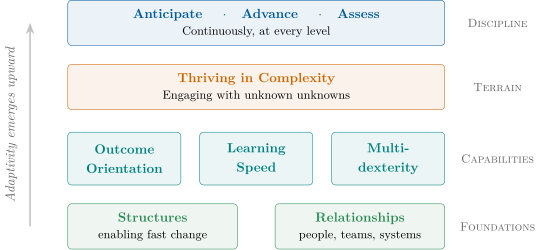
For structures, ask how long approval takes for a change close to the work, days or weeks? Where does decision authority actually sit, with the people who have the knowledge, or higher up where the information is slowest to arrive? A governance process that takes weeks to approve a change is a structural impediment, however well-intentioned.
For relationships, ask whether people trust one another enough to share information, raise problems and challenge assumptions without fear (Edmondson, 1999). Structures without healthy relationships produce compliance without commitment. Relationships without enabling structures produce goodwill without capability. If either base is missing, score this clause one or two, because the layers above it cannot carry their load. A three here means the foundations are real but uneven: some parts of the organisation make decisions fast and speak freely, while others still route every change through a slow centre. Because everything else depends on this layer, an unfinished foundation is the most dangerous three on the whole sheet.
Check two: the outcome clause
The shortest and most consequential clause reads it organises around outcomes. An outcome is what changes for the people you serve. An output is what you deliver. The distinction shapes how you define success, structure teams, and allocate resources.
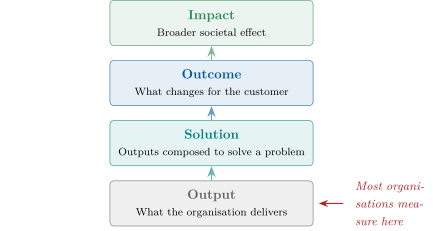
Ask what your teams are actually rewarded for: features shipped, projects completed and tickets closed, or problems solved, conditions improved and needs met? What was the last output your organisation shipped that demonstrably changed something for a customer? When you design a new offering, do you start from the change it should create and work backwards, or do you define the solution and hope a useful change follows?
An organisation measured on outputs can be extraordinarily busy without being effective. If your scorecards and your bonuses reward delivery over improvement, score this clause one or two. The shift from inside-out thinking, what do we offer, to outside-in thinking, what changes for the people we serve, is the whole of this check. A three here is the classic staging point: teams speak fluently about customers and outcomes, yet the quarterly targets that decide pay and promotion still count units shipped. The language has moved ahead of the scorecard.
Check three: the learning clause
The most demanding clause in the definition sets a relative standard. An adaptive organisation learns faster than its environment evolves. The benchmark is not your own past performance or your competitors. It is the rate at which markets, technologies, regulations and customer expectations are changing around you. de Geus (1997) named learning speed as the only sustainable advantage; the definition widens the target to the environment itself.
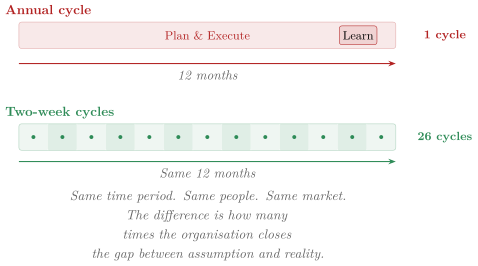
Ask how quickly your organisation’s understanding updates compared with the market it faces. Is learning embedded in daily work as short experiments and cheap failures, or is it aspirational, confined to training days and post-mortems that rarely change the plan? In a slow environment, slow learning is enough. In the environment most organisations now face, learning speed is a matter of survival, because an organisation that learns more slowly than its surroundings falls behind no matter how much it learns in absolute terms. If your learning is structural in intent but annual in practice, score this clause two or three. A three means the cycle genuinely runs in places: teams experiment and adjust weekly, and their findings regularly change their own work. The gap is vertical: what the teams learn rarely travels up to change a decision the organisation as a whole has already taken.
Check four: the tension clause
The last capability clause asks your organisation to hold the tension between today’s operations and tomorrow’s opportunities. Note the verb. It is hold, not resolve. The definition deliberately refuses the comfort of choosing one side.
Ask what happens when today and tomorrow compete, and which always wins. Do you have teams, metrics and time horizons for protecting what pays the bills and for building what will pay them in five years? March (1991) framed this as exploration and exploitation; O’Reilly and Tushman (2004) called it ambidexterity; the definition extends it to multidexterity, adding the middle mode in which a rough idea is made reliable before it is scaled.
Choosing exploitation makes you efficient and risks obsolescence. Choosing exploration makes you innovative and risks insolvency. An organisation that cannot point to active work on both sides is not holding the tension, it is avoiding it, and it will pay for the avoidance in whichever direction it tipped. If one side always cannibalises the other, score this clause one or two. A three means both sides have a seat at the table but not equal weight: there is real investment in tomorrow, in an innovation unit or new-offering work, yet the moment money gets tight the exploration budget folds first. The tension is acknowledged and only provisionally held.
Check five: the terrain clause
The second clause stops describing your organisation and starts describing your world. An adaptive organisation thrives in complexity, engaging with unknown unknowns. The hidden requirement is that your way of working must be built for a world where you can only understand cause and effect in retrospect, not for a predictable machine.
Ask how your planning really treats the future. Does your process assume you can predict the future and then control it? When the unexpected arrives, do you treat it as a threat to the plan or as new data? How much of your energy goes into making a detailed forecast accurate, and how much into shortening the time between acting and learning what happened?
An organisation that plans, executes and controls is built for a complicated world, one whose parts an expert can eventually map. An organisation built for complexity probes, senses and responds, drawing the map as it goes. If your instinct is to eliminate uncertainty with more detail rather than to engage with it through experiment, score this clause one or two. A three here is common in organisations that sit between the two worlds: they run experiments and accept uncertainty at team level, then insist on a detailed, locked annual forecast at the top. The terrain is recognised below and denied above.
Check six: the discipline clause
The definition opens with a demand: anticipate, advance and assess empirically, continuously, at every level. Read it as a specification and the first question is not whether your organisation likes learning. It is whether learning actually happens on a cycle, and how fast. Check this one last, because everything it measures depends on the foundations and capabilities you have already scored beneath it.
Ask these questions at the level of the whole organisation, not your teams. When did your leadership last form a hypothesis and deliberately test it? On what calendar does your organisation, rather than just individual teams, update its understanding: a day, a quarter, or a year? Can anyone you ask point to a recent experiment that changed a strategic decision?
The structural consequence is stark. An organisation whose empirical cycle runs annually is limited to annual adaptation, no matter how hard the teams inside sprint on a weekly rhythm. If your answer to these questions lives at the team level and dies at the top, score this clause one or two. The definition is not satisfied by busy teams inside a static system. A three means the cycle runs everywhere there is freedom to act, but stalls wherever authority is slow, which is why a three on discipline so often travels with a low score on the foundations beneath it.
Reading your results
When you have scored all six clauses, resist the urge to average them. The specification is not a single number. It is a building, and a building is only as sound as its weakest load-bearing element. A high score on discipline with a failing score on foundations means you are reciting the top layer while the base is unfilled, which is the failure mode the whole architecture warns against.
A summary of the checks follows, with space to note the evidence behind each score.
| Clause | Score (1 to 5) | Evidence you would point to |
|---|---|---|
| 1. Foundations: structures and relationships sound | ||
| 2. Outcome: measured on outcomes, not outputs | ||
| 3. Learning: faster than the environment evolves | ||
| 4. Tension: today and tomorrow held at once | ||
| 5. Terrain: built for complexity and unknown unknowns | ||
| 6. Discipline: empirical cycle runs continuously at every level |
Reading honestly, no organisation scores a five on every clause, because the definition describes a direction rather than a finished state. That is the point of a specification as opposed to a slogan: a slogan is either believed or not, a specification is always being approached. The useful reading is not in the total. It is in which clauses fail together, because that points at where the load actually falls.
The pairs that fail together are not random, and one pattern is worth naming because it is the most common. Consider an organisation that scores itself four on learning. Its teams run short experiments, inspect the results and adjust each week, and the evidence is real. But the same organisation scores two on foundations, because any change that touches more than one team needs an approval that takes weeks and sits with executives far from the work. The two scores fail together and this is why: learning is only as fast as the slowest path the load must travel. Every experiment that needs budget or cross-team authority waits on the same slow approval, so the learning the teams generate in the small space the structure allows can never change anything above them. The learning is genuine and the foundation strangles it. Read the pair and you can see exactly where the load lands, on the foundation, and you can predict the consequence before you look: the discipline above will read as a facade, because the structure gives it no way to act.
The six checks are designed for a working session with your team and the summary sheet above. For a first snapshot, you can also take the Society’s interactive self-assessment: ten questions that follow the definition clause by clause, each rated from one to ten, ending with a spider diagram of your organisation’s profile that you can download or save as a PDF.
Sources
- de Geus, A. (1997). The Living Company. Harvard Business School Press.
- Edmondson, A. C. (1999). Psychological safety and learning behavior in work teams. Administrative Science Quarterly, 44(2), 350 to 383.
- Society for Adaptive Organisations (2026). Adaptive Organisations: Thriving in Complexity.
- March, J. G. (1991). Exploration and exploitation in organizational learning. Organization Science, 2(1), 71 to 87.
- O’Reilly, C. A., & Tushman, M. L. (2004). The ambidextrous organization. Harvard Business Review, 82(4), 74 to 81.
- Snowden, D. J., & Boone, M. E. (2007). A leader’s framework for decision making. Harvard Business Review, 85(11), 68 to 76.
About this article. This article is a short, adapted summary of one of the core topics of the book Adaptive Organisations: Thriving in Complexity, written and published by the Society for Adaptive Organisations (2026). The full treatment of the subject, together with the supporting argument and reference materials, is developed in the book. Further resources and the book itself are available at adaptive-organisations.org.