Three Hands Are Better Than Two
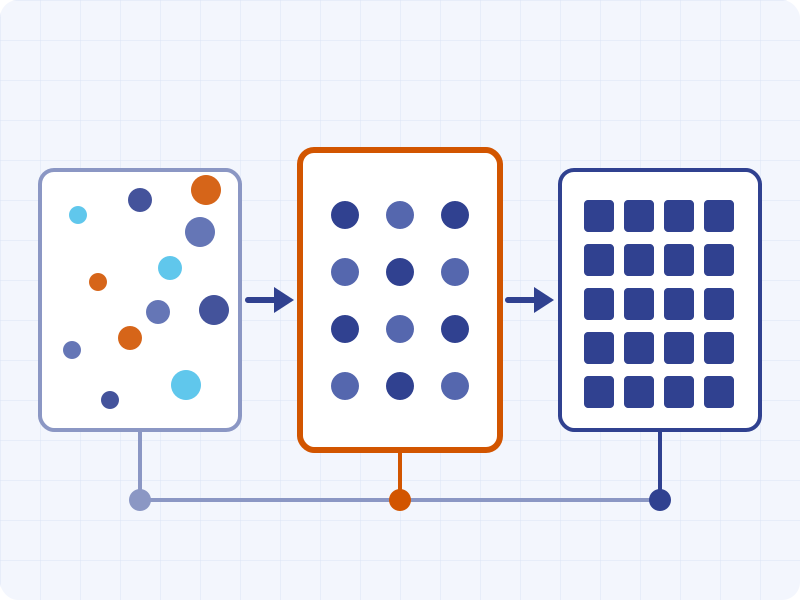
Why organisations must explore, exact and exploit all at once
An article in the series “The Dimensions of Adaptivity”. The previous article, Why Your Organisation Always Finds Out Too Late, explains fast improvement cycles.
Multidexterity extends the Organisational Ambidexterity pillar of the Society’s reference model on the home page with the third mode the classic framing leaves out: exact, the work of making a discovery reliable.
The gap between a great idea and a reliable one
Anyone who has turned a promising recipe into a dependable dish knows the gap this article is about. Inventing the dish is the exciting part, tasting and adjusting while the idea is young. Running a restaurant is the disciplined part, repeating the dish exactly, every night, for forty tables. Between the two sits the unglamorous phase that decides success: turning a dish that impressed eight friends into one that is identical when it is the three hundredth portion sold that month. Change nothing else and the restaurant fails or succeeds on that middle work.
Organisations face the same three phases, and most design for only two of them. The traditional framing, called ambidexterity, gives organisations two hands: one to exploit the known, one to explore the new (March, 1991; O’Reilly & Tushman, 2004). Valuable as that framing is, it misses the middle. Between a raw discovery and a scaled business sits the work of making a rough idea reliable, repeatable and ready for industrialisation. The Society for Adaptive Organisations calls the capacity to do all three at once organisational multidexterity, and it treats the missing middle as the place where most innovations actually die.
The S-curve gives adaptivity its deadline
Think about why this middle phase matters so much. Every product and every service follows the same arc. It begins as an uncertain idea, gains traction, matures into a reliable offering and eventually becomes a commodity whose margins thin as competitors match it. The organisation that built its success on the mature phase, the phase of predictable revenue and optimised processes, wakes up one day to find the arc bending downward, and the only way to survive beyond any single product is to start the next curve before the current one peaks.
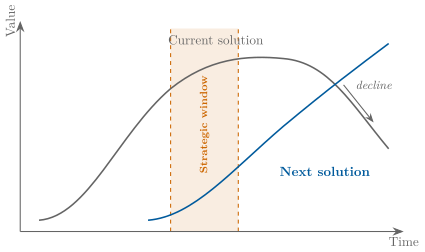
This is the Innovator’s Dilemma described by Christensen (1997). Successful companies fail because they are excellently managed for the wrong phase. Their resources flow to where returns are predictable, starving the uncertain future to feed the certain present. Their processes are tuned for the current business, so the stage-gate that develops the next version of an existing product is catastrophically slow for testing something new. And their values, the criteria people use to decide what matters, mark exploratory work as illegible: it serves customers who do not yet exist and threatens margins that exist today. The opportunity is not so much rejected as structurally invisible.
Three modes, three different ways of working
Multidexterity names the three modes explicitly, because each demands different structures, metrics and culture, and they cannot be run inside a single set.
Explore is the mode of discovery. It operates in genuine uncertainty, runs experiments where most will fail and measures success by learning rather than by output. Its culture values creativity, risk-taking and tolerance for failure. This is the domain of the pioneer.
Exact is the neglected middle. It takes a rough discovery and makes it work reliably: refining the prototype into a product, establishing repeatable processes and quality standards, and turning “it works sometimes” into “it works every time”. Success is measured by the transition from an unreliable idea to a dependable one. Its culture values craftsmanship, feedback and disciplined improvement. This is the domain of the settler.
Exploit is the mode of scale. It industrialises, standardises and optimises for efficiency, driving down cost and extracting maximum value from the mature offering. Success is measured by throughput and margin. Its culture values reliability and operational excellence. This is the domain of the town planner.
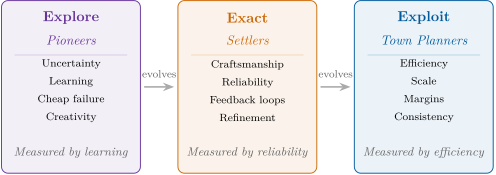
The vocabulary of pioneers, settlers and town planners comes from Wardley’s (2016) work on how all parts of a value chain evolve from genesis through custom products to commodities. The insight is that evolution through these stages is natural; it happens whether it is managed or not. The question is whether the organisation has the structural capacity to support all three at once, or whether its structures, incentives and culture are tuned for only one.
Separate structures, protected investment
Because the modes cannot compromise each other, multidexterity is a structural capability rather than a matter of asking the same teams to “be more innovative”. The classic proof is the Skunk Works, the small autonomous team that Kelly Johnson separated from Lockheed in 1943, with its own rules, its own resources and a ban on corporate executives visiting. It produced some of the most innovative aircraft ever built precisely because it operated under different rules from the parent organisation. The lesson is not secrecy for its own sake. It is that exploration needs its own resources, its own governance and its own success criteria, and that running it inside the exploitation machine lets exploitation win every time, because exploitation is measurable, predictable and immediately rewarding in ways exploration is not.
The Three Horizons framework offers a practical way to manage the balance (Baghai, Coley, & White, 1999). Horizon I is the current core business that generates today’s revenue. Horizon II is emerging opportunity, where discoveries are being turned into viable businesses, the exacting phase. Horizon III is future possibility, the exploration that may pay off in years. An adaptive organisation invests deliberately across all three, and protects that allocation from the gravitational pull of the current quarter, because the natural tendency is to over-invest in the present and starve the future it depends on.
Ask about your own three modes
Now bring this back to your own organisation. Name it plainly: what is the current cash cow, the thing whose reliability pays the bills? Now, separately, what is being explored that might replace it, and when did you last see a genuinely new idea that was neither the cash cow nor the next version of it? And between the two, what is being exacted, turned from a promising demonstration into something that works reliably for every customer?
Then check where the money actually goes. When an exploratory initiative must compete for funding against an exploitation initiative that returns revenue this quarter, which wins, and is that decision made by a design that protects the future or by default? Look for the bottleneck in the middle: organisations commonly celebrate discovery and pay for scale, but starve the exacting work, the settlers who turn a lab result into a dependable product. If you can point to exploration and to exploitation but cannot point to the middle, you have found the gap where your discoveries will fail.
The hard part of multidexterity is that it is not a sequence. It is a simultaneous holding of three modes, and it asks leaders to sustain a tension that simpler organisations resolve by choosing. That is why many organisations quietly choose, exploiting what is safe and letting the future arrive as a surprise. The organisations that fail this way are rarely short of talent or ambition. They are short of the structural commitment to hold all three phases alive at once, and to protect the middle one that everyone forgets.
The pain of letting go
One more honest note before the close. Multidexterity also demands letting go of old structures when they no longer serve, and that is painful. Structures carry identity, relationships and emotional investment. The factory that built a town, the product that defined a brand, the team that carried the organisation through its growth years: these are losses, not just operating decisions. Organisations resist loss, and the Innovator’s Dilemma is emotional as well as intellectual.
But the alternative is worse. An organisation that cannot release the old will pour increasing resources into maintaining what no longer generates value, crowding out the future. Seen this way, reorganisation is a sign of adaptation rather than failure: the world moved, and the organisation moves with it. The leaders who manage the transition are the ones who feel the attachment and act anyway, because they understand that the organisation’s future depends on holding three hands, not on refusing to let go of one.
Sources
- Baghai, M., Coley, S., & White, D. (1999). The Alchemy of Growth. Perseus Books.
- Christensen, C. M. (1997). The Innovator’s Dilemma. Harvard Business School Press.
- March, J. G. (1991). Exploration and exploitation in organizational learning. Organization Science, 2(1), 71 to 87.
- O’Reilly, C. A., & Tushman, M. L. (2004). The ambidextrous organization. Harvard Business Review, 82(4), 74 to 81.
- Society for Adaptive Organisations (2026). Adaptive Organisations: Thriving in Complexity.
- Wardley, S. (2016). Wardley Maps. [Self-published].
About this article. This article is a short, adapted summary of one of the core topics of the book Adaptive Organisations: Thriving in Complexity, written and published by the Society for Adaptive Organisations (2026). The full treatment of the subject, together with the supporting argument and reference materials, is developed in the book. Further resources and the book itself are available at adaptive-organisations.org.