Why Sound Product Management Is the Engine of Adaptive Organisations
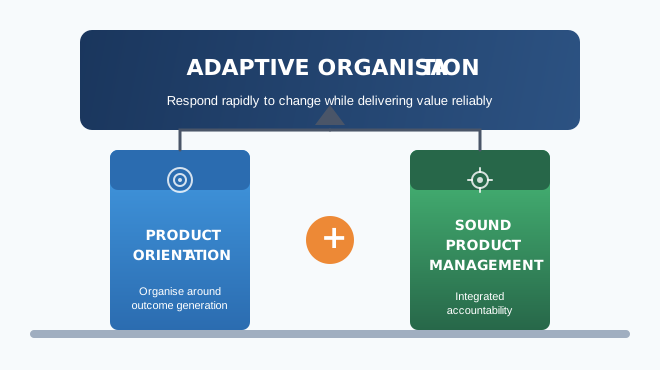
Organisations today face a paradox. They must deliver value reliably today whilst simultaneously preparing for an uncertain tomorrow. The ability to respond rapidly to change whilst guaranteeing operational excellence is no longer a competitive advantage. It’s a requirement for survival.
This is what we call an adaptive organisation.
Yet many organisations struggle to become truly adaptive. They adopt agile methods, invest in new tools, and send people on training courses. The results often disappoint. Why? Because adaptiveness is primarily a structural problem. When the core work of creating value fragments across too many separate roles and departments, no amount of individual skill can overcome the structural barriers.
This is the same problem that has plagued agile adoptions for years. Organisations create “product owner” roles but embed them in structures that prevent actual ownership. The title exists, but the empowerment does not.
The same fate awaits organisations that treat product management as a capability to be developed without first making the structural changes that enable it to function. The path to adaptiveness has two parts, and the sequence matters. First, organisations must make the structural shift to product orientation, organising around value streams rather than functional silos. Second, they must establish sound product management with real authority.
From Functional Silos to Product Orientation
Traditional organisations structure themselves around functions: marketing, sales, engineering, operations, support. Each department optimises for its own concerns. The cracks appear at the interfaces between these groups.
Adaptive organisations take a different approach. They organise around products and the generation of value for actual customers. Teams form around the outcomes they deliver to customers, not the activities they perform internally.
This product orientation is the structural bedrock that enables adaptability.
But product orientation without clear product accountability creates its own problems. When multiple people influence a product without coordination, you get contradictory decisions, confused development teams, and products that excel in disconnected pieces whilst failing to provide a coherent experience.
This is where sound product management becomes essential. It serves as the single point of accountability that ensures all activities align toward a coherent product designed to succeed in the market. Product management owns the outcome of the whole. When the product fails, you cannot point to excellent code quality or beautiful designs as an excuse. Product management is accountable for combining these efforts into something that actually succeeds.
The Unique Value Product Management Creates
What makes product management so valuable to adaptive organisations?
Consider the alternatives. Without sound product management, who decides whether a sales-driven feature request fits the roadmap? Who evaluates whether marketing’s positioning accurately represents the product? Who weighs engineering’s technical concerns against customer needs? Who balances short-term demands against long-term sustainability?
In organisations without empowered product management, these decisions either don’t get made (leading to incoherence) or require endless committee meetings (killing responsiveness).
Product management creates value by holding the complete picture and enabling these decisions to be made quickly and coherently. This integrated accountability across the entire product lifecycle is precisely what adaptive organisations need. It spans from market understanding before anything is built, through strategy and prioritisation during development, to measurement and learning after the product reaches customers.
When product management holds this complete view, decisions happen fast. When authority fragments across multiple roles, coordination overhead slows everything down.
Fast Learning: The Heart of Adaptiveness
Adaptive organisations must learn faster than their environment changes.
Product management makes this possible by maintaining continuous balance between discovery and delivery. Discovery is the work of learning what to build. Delivery is the work of building what you’ve decided.
Many organisations emphasise delivery whilst neglecting discovery. They ship features rapidly but don’t actually solve customer problems. They waste effort building things nobody wants because they never validated their assumptions.
Fast delivery is worthless if you’re delivering in the wrong direction.
Other organisations fall into the opposite trap. They research endlessly whilst never actually shipping anything. They become so focused on reducing uncertainty that they forget the goal is to create value, not to achieve perfect knowledge.
Sound product management maintains both activities continuously. The best product teams run discovery and delivery in parallel. They constantly learn whilst constantly shipping. Product management ensures that learning rate outpaces environmental change velocity. This is the mechanism through which adaptive organisations maintain their responsiveness.
Strategic Discipline: The Power to Say No
Every product faces more opportunities than it can pursue. Strategy is the discipline of deciding what you will focus on and, equally important, what you will not do.
Adaptive organisations need this discipline even more than traditional ones. When you can respond quickly to change, the temptation to respond to everything becomes overwhelming. Without clear strategic boundaries, responsiveness degenerates into reactiveness. The organisation loses coherence.
Product management provides the framework for saying no. It answers fundamental questions. Which customer segments will we target? Which problems will we solve? What is our source of competitive advantage?
When someone proposes a feature that doesn’t fit the strategy, product management provides a principled reason to decline rather than just personal preference.
This clarity enables the organisational ambidexterity that adaptive organisations require. It allows organisations to balance exploitation of current operations with exploration of future advancements. Strategic product choices determine how the organisation shifts between them responsively rather than treating them as separate initiatives.
Collaboration That Creates Coherence
Product management cannot succeed in isolation.
Every product is ultimately the result of what we want to create meeting the reality of what we can create. Product management holds the vision of what should exist. Development holds the knowledge of what can exist. Effective product management happens where these meet, through continuous dialogue and joint problem solving.
Product management steers the multi-dimensional optimisation that every product represents. It balances customer needs against technical constraints. It weighs short-term demands against long-term sustainability. It reconciles ambitious goals with realistic timelines. It builds sufficient alignment across the organisation so the product can move forward.
This doesn’t mean making everyone happy.
It means ensuring that disagreements get resolved and the organisation can act coherently. In an adaptive organisation where speed matters, this is essential. Unresolved conflicts slow decision making. Slow decision making undermines responsiveness.
The Road Ahead
If your organisation aspires to become more adaptive, start with a fundamental question. Does your organisational structure actually allow product management to function effectively?
Ask whether product management has clear accountability for outcomes, not just activities. Ask whether it maintains authority across the entire product lifecycle or whether that authority fragments across functional silos. Ask whether discovery and delivery run continuously in parallel. Ask whether the strategy provides clear guidance for saying no.
New meetings, better tools, and training programmes cannot substitute for the structural shift to product orientation. And product orientation without empowered product management produces disjointed products.
You need both, in the right sequence. Structure first, then capability. Get this right, and sound product management becomes the engine that drives your organisation’s adaptiveness.