Principles of an Adaptive Organisation
Principles of an Adaptive Organisation
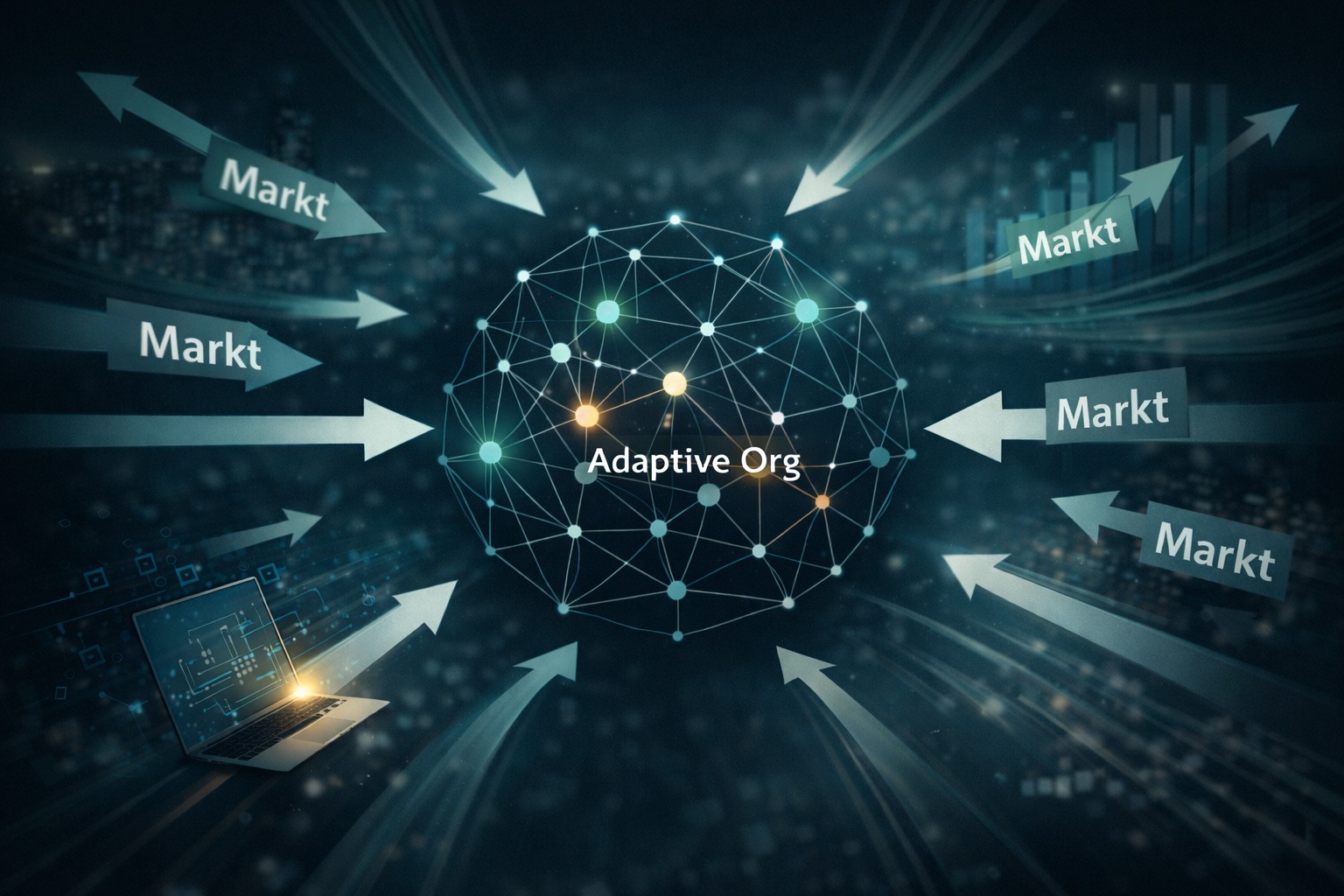
Organisations today operate in environments shaped by accelerating change, growing interdependencies, and increasing uncertainty. In such conditions, traditional management approaches—optimised for stability, predictability, and control—reach their limits. An adaptive organisation is not defined by agility frameworks, structural blueprints, or cultural slogans. It is defined by its ability to act effectively under uncertainty, to learn faster than its environment changes, and to continuously align today’s operations with tomorrow’s opportunities. The following principles describe the foundations from which such adaptivity emerges.
1. Decisions create adaptivity — not structures alone
Adaptivity does not primarily emerge from organisational charts, roles, or formal processes. It emerges from how decisions are structured: who makes which decisions, based on what information, with what level of autonomy, and with what consequences. In adaptive organisations, decisions are made as close as possible to the relevant context and knowledge. Authority follows responsibility. Decision-making is designed for speed, for reversibility where possible, and for learning through feedback. In adaptive organisations, decision authority and economic responsibility are inseparable. Teams that own outcomes also carry the full economic consequences of their decisions and therefore control the allocation of the resources they need. Centralised budgeting without decision authority is incompatible with adaptivity. This coupling enables faster learning, explicit trade-offs, and effective action in the interest of customers and the organisation under uncertainty. Adaptive organisations are committed to solving market and customer problems; therefore, they are designed from the outside in.
2. Leadership is a continuous learning practice
Leadership in adaptive organisations is not a position or a state to be achieved. It is an ongoing practice of sense-making, learning, and adjustment that emerges through collaboration. Leaders are not primarily controllers of execution; they are designers of conditions. They continuously reflect on how their decisions, behaviours, and assumptions shape the system—and adapt accordingly. This requires the willingness to learn from outcomes rather than intentions, and to change one’s own actions when reality demands it.
3. Self-organisation is a prerequisite, not an option
Adaptive capacity depends on the organisation’s ability to respond locally and autonomously to emerging situations. This is only possible when teams are trusted with real responsibility and are equipped with the competence and capability to act. Self-organisation is not the absence of structure. It is the presence of clear goals, clear boundaries, and real decision authority at every level. Adaptive organisations systematically remove structural impediments to self-organisation and replace control with transparency, feedback, and accountability. Without self-organisation, responsiveness remains slow and learning remains centralised.
4. Effectiveness is measured by outcomes, not activity
In complex environments, effort and busyness are poor indicators of success. Adaptive organisations therefore focus relentlessly on outcomes and impact. Actions, initiatives, and decisions are evaluated based on the effects they produce in reality—not on compliance with plans or methods. This creates clarity about what works, what does not, and what needs to change. Learning accelerates when organisations are honest about results and willing to adjust course.
5. Complexity is accepted — and actively shaped
Complexity is not an anomaly to be eliminated; it is the natural condition of modern organisations. Adaptive organisations do not attempt to oversimplify reality through rigid plans or excessive control. Instead, they build the capability to navigate uncertainty, experiment safely, and respond dynamically. They design for emergence rather than predictability and acknowledge that not all outcomes can be planned in advance. This requires tolerance for ambiguity and discipline in learning.
6. Learning happens at every level of the system
Adaptivity depends on continuous learning—individually, collectively, and systemically. Adaptive organisations shorten feedback loops, encourage reflection, and treat mistakes as sources of insight rather than failure. Learning is not confined to training programs; it is embedded in daily work, decision-making, and collaboration. The organisation evolves because learning is an integral part of how it operates—and because learning opens the door to innovation.
7. Collaboration and responsibility are structural principles
Complex problems require collective intelligence. Adaptive organisations enable diverse ways of thinking and acting to address them. As value emerges through collaboration, individual incentive systems are counterproductive and have been shown to negatively affect organisational effectiveness. Effective collaboration does not emerge from good intentions alone. It requires deliberate structural design that aligns responsibility, decision-making, and evaluation across boundaries. Individual optimisation is actively designed against, as it undermines learning, trust, and the ability to act effectively in complexity. Responsibility is explicit, shared goals are clear, and dependencies are transparent. Collaboration becomes a structural property of the organisation—not an additional practice layered on top.
Closing
An adaptive organisation is not built by adopting a single model or framework. It emerges when decision structures, leadership practice, self-organisation, collaboration, and learning are aligned toward effectiveness under uncertainty. Adaptivity is not a destination. It is a continuous capability—cultivated through deliberate design, reflection, and the courage to change what no longer works.