Books
The Society for Adaptive Organisations gathers the experience of its educators into publications that anyone can read, quote and put to work. Our first book is out now.
Adaptive Organisations: Thriving in Complexity
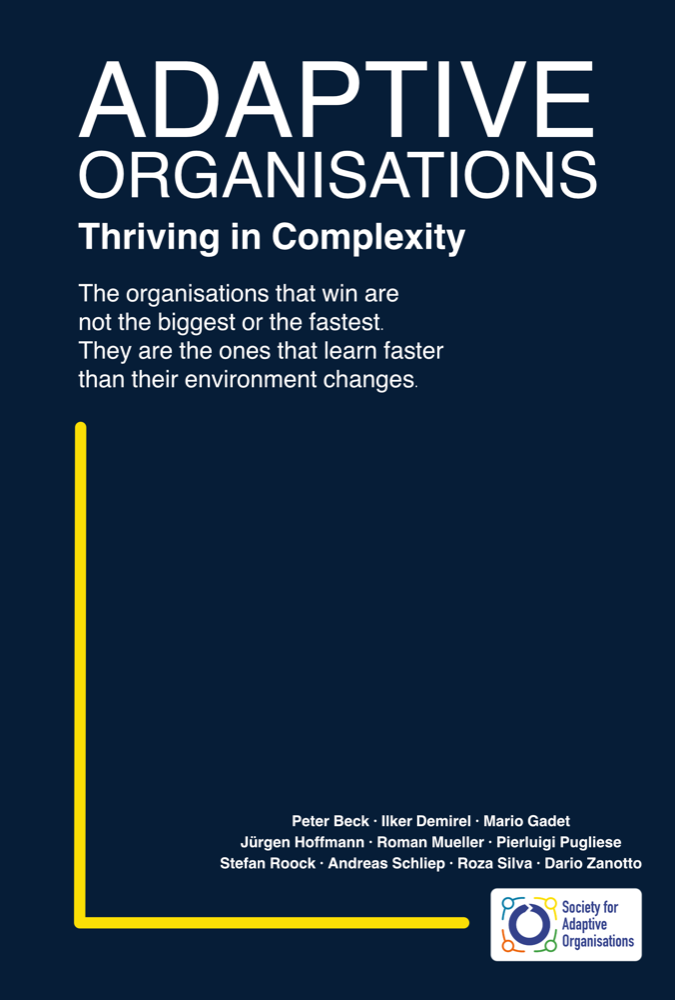
The organisations that win are not the biggest or the fastest. They are the ones that learn faster than their environment changes.
A precise definition of adaptivity, twelve principles that make it operational, and a practical answer to the question of where to start.
- Formats:PDF and EPUB
- Price:From $18, suggested price $25
Published in English. Translations are under consideration.
About the book
In September 2024, Mario Draghi handed the European Commission a 400-page report with a blunt conclusion: Europe faces an existential challenge. The GDP gap with the United States had widened from 17% to 30% in twenty years. The diagnosis pointed at structures that are too slow and too fragmented to turn talent, capital and ambition into results.
Strip away the scale and that is a description of a company.
Organisations fail the same way at every size when the structures through which they decide are slower than the world they are deciding about. A continent takes nineteen months to move a regulation from proposal to adoption. A manufacturer takes months to approve a product change as it crawls through a chain of committees. Same mechanism, different scale.
This book is about what to build instead. Its definition comes from the Society for Adaptive Organisations, built on a century of accumulated evidence and refined against engagements across industries, sizes and geographies:
An adaptive organisation anticipates change, advances decisively and assesses empirically, continuously, at every level. It thrives in complexity, engaging with unknown unknowns. It organises around outcomes, learns faster than its environment evolves and holds the tension between today’s operations and tomorrow’s opportunities. Adaptivity emerges from structures that enable fast change, and from the healthy relationships between people, teams and the systems that connect them.
One idea shapes everything that follows: adaptivity is an emergent property. It arises from the interplay of structures, practices, relationships and leadership behaviours, and fades when those conditions erode.
How the book helps
One definition to argue about. Conversations about agility stall when everyone means something different by it. The book supplies one precise definition and twelve principles that make it operational, so a leadership team can disagree productively.
A mirror for where you stand. The assessment asks honest questions grouped around the core dimensions, and treats truthful answers as more useful than right ones. Gather ten people from different departments and ask what your organisation’s solution is: how many answers do you get? When something goes wrong, how long before the organisation responds?
The patterns that will show up. Nine ways adaptivity gets quietly sabotaged. Among them: passive non-participation, death by prioritisation, framing it as fluff, complying without committing, compliance theatre. Described so you recognise them in the room, because you will meet them.
What to do on Monday morning. A Solution Diff for getting clear on what you are building, the shifts leaders have to make, first steps chosen because they generate learning, and a Dos and Don’ts table for the early weeks. The principles work as a compass consulted along the way.
A way to make the invisible arguable. Visualise, Discuss, Adapt: visual working methods that surface what a team believes about its own system, so the structure beneath the work becomes discussable.
What is inside
Twelve chapters in four parts, with forty-one diagrams, a glossary, a bibliography, further reading and an index.
Part I: The Case for Adaptivity
- A World That Has Fundamentally Changed
- The Adaptive Organisation
Part II: Foundations
- Theoretical Foundations
- Principles of Adaptive Organisations
Part III: The Core Dimensions
- Solution Orientation
- Fast Improvement Cycles
- Organisational Multidexterity
- Adaptive Leadership
- Healthy Relationships
Part IV: The Path to Adaptivity
- Adaptivity-Sabotaging Patterns
- Beginning the Voyage
- Excursus: The Power of Visualisation
Who it is for
Leaders who can see their organisation deciding too slowly and want something more precise than “be more agile”. Coaches and consultants who need a defensible definition and a shared vocabulary. Anyone who has watched a good strategy die in a governance process and wants to understand the mechanism.
The authors
The book was written collectively by ten members of the Society, most of them educators who teach and coach adaptivity in practice:
Peter Beck · Ilker Demirel · Mario Gadet · Jürgen Hoffmann · Roman Mueller · Pierluigi Pugliese · Stefan Roock · Andreas Schliep · Roza Silva · Dario Zanotto
Get the book
The book is sold through Leanpub in PDF and EPUB format. Leanpub lets you choose what you pay: the minimum price is $18 and the suggested price is $25.