Why Your Organisation Always Finds Out Too Late
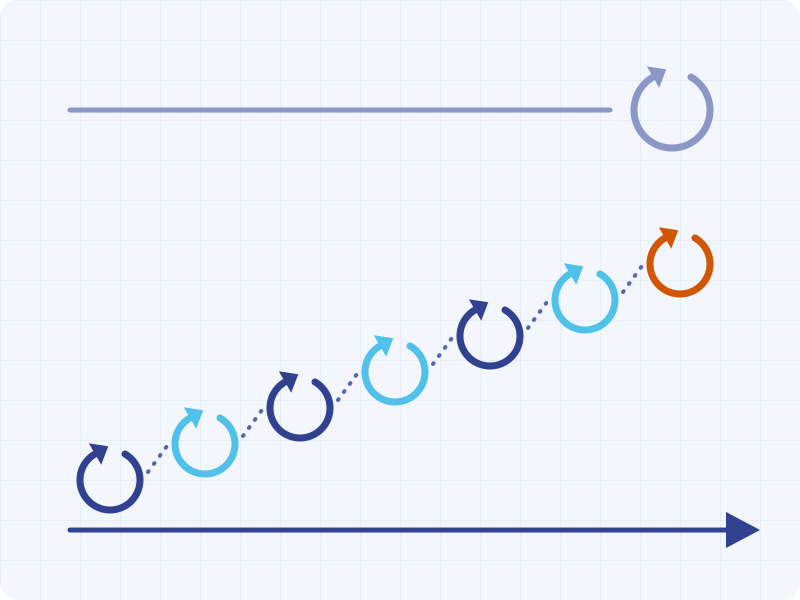
The fastest learner wins, and only the cycle length decides who that is
An article in the series “The Dimensions of Adaptivity”. The first article, Organising Around the Customer, explains solution orientation, the dimension this one builds on.
Fast improvement cycles are one of the three pillars of the Society’s reference model on the home page, alongside Product Orientation and Organisational Ambidexterity.
The question nobody asks twice
Every strategy that arrives too late begins the same way. The market moved, a competitor stepped in or a technology shifted, and the organisation was still preparing to respond. Afterwards, the post-mortem usually asks why the plan failed. Almost never does it ask the question that would have been more useful earlier: why did we find out so late?
A hunter’s trap is a good way to see why that distance matters. A hunter who checks a trap once a month learns one thing a month about whether it works. A hunter who checks every morning learns thirty times more, not because they are smarter, but because they get feedback more often, and each piece of feedback guides the next decision. Put the same hunter in a world where the game changes constantly, and the one who gets feedback daily adapts while the one who gets it monthly is always a season behind reality.
The same arithmetic governs organisations. The distance between what an organisation assumes to be true and what is actually true is its real measure of risk, and the speed at which it closes that gap is its rate of learning. In a stable market the cost of closing it slowly is modest. In the environment most organisations now face, where geopolitics, technology and competition compress the time available to respond, the cost is existential.
Treat plans as hypotheses, not commitments
Most organisations are built around plans: annual budgets, quarterly targets, roadmaps with sign-off gates. This arrangement made sense when a plan drawn in January would still reflect reality in December. For most organisations that world is gone, and the deeper problem is not that plans become outdated. It is that plans are treated as commitments rather than hypotheses.
When a plan is a commitment, every deviation from it is a failure to be explained. When a plan is a hypothesis, every deviation is evidence to be examined. The first posture builds organisations that defend their assumptions. The second builds organisations that learn from reality. Deming and Shewhart established this distinction decades ago as the empirical cycle: treat every decision as a hypothesis, test it against reality and learn from what actually happens (Deming, 1986; Shewhart, 1939). The Society’s definition of an adaptive organisation, anticipate, advance, assess, is this same cycle raised to a discipline. The plan is the anticipation. The advance is the deliberate step. The assessment is the honest look at what the step produced. Then the loop starts again.
The length of that loop determines the number of learning opportunities available in any period. An organisation that runs the cycle monthly gets twelve chances a year to close the gap between assumption and reality. One that runs it weekly gets fifty-two. One whose most consequential decisions are locked into annual cycles gets one.
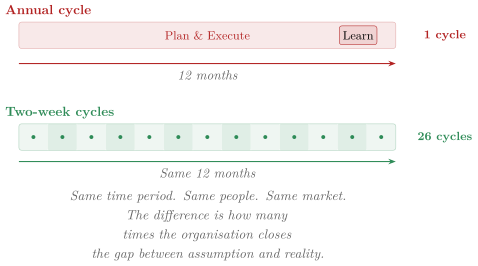
The compounding is not linear. Each cycle builds on the insight of the one before it, so an organisation that learns fifty times a year enters the next year with a fundamentally different picture of its customers, its market and its own capabilities, while a competitor on four cycles a year is still acting on beliefs formed months ago.
Shortening the cycle is not working faster
Shortening the cycle does not mean working faster. It means reducing the distance between action and understanding, and every approval step, handoff and review gate that separates the moment of acting from the moment of learning adds to that distance without adding insight. Reinertsen (2009) showed why organisations understate this: they measure the cost of the work but not the cost of the waiting, so delay that every manager can feel is systematically invisible in the accounts.
This is where solution orientation meets fast improvement cycles. A solution is the complete experience through which a customer’s problem is identified, addressed, delivered and supported, not a feature in isolation, and the improvement cycle must run across all of it. An organisation that runs fast cycles in engineering but slow cycles in sales or support has shortened one segment of a chain and left the rest untouched, and the slowest cycle in the chain constrains the whole system.
Discovery, delivery, adoption and support each need the same loop. Discovery means treating every understanding of customer needs as a hypothesis, tested through direct contact with customers rather than filtered through layers of management. Delivery means releasing frequently and measuring what actually changed. Adoption means treating a pricing model or a go-to-market plan as testable, not fixed. Support means treating every interaction as a signal that closes the loop back to discovery. If any stage runs on a slow cycle, the learning produced everywhere else is diluted by the inertia of that one stage.
Three conditions must be in place together
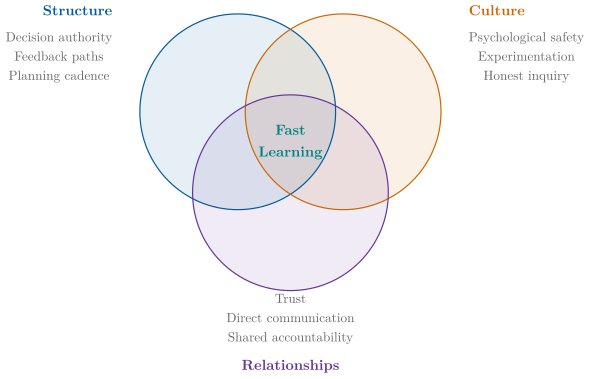
Short cycles do not emerge from methodology alone. An organisation can run retrospectives faithfully and still learn nothing, because the conditions around the practice decide whether it works or merely looks as though it does. Three categories of conditions must hold at once.
Structural conditions decide whether the organisation can run fast cycles. The first is decision authority placed close to the knowledge: the people who own an outcome must also carry the power to act on it, so that the person who decides also experiences the consequence. When decisions travel upward for approval, the distance between action and feedback lengthens, and the people closest to the evidence are not the ones making the call.
Cultural conditions decide whether people are willing to run them. Experiments fail, and negative results must be treated as data rather than grounds for blame. Edmondson (1999) showed that psychological safety is the precondition for team learning: without it, information is withheld, mistakes are hidden and the honest feedback that drives improvement is severed. Culture here follows leadership, because the signal of what is safe to report is set by how leaders receive bad news.
Relational conditions decide whether the resulting learning flows. Trust is the medium through which information moves; when it is absent, information is filtered, delayed and sanitised at every handoff. Direct communication and shared accountability, teams owning outcomes rather than defending individual scores, complete the set.
Ask about your own rhythm
Now ask yourself a small set of questions, and be honest about the answers. On what calendar does your organisation as a whole update its understanding, not your teams, but the organisation: a day, a quarter or a year? When did a failed experiment last change a strategic decision, and would producing that evidence have been safe for the person who ran it? Does the slowest stage of your value stream, discovery, sales or support, shorten your whole learning loop?
Then look at the decision structure. Can the people closest to a customer problem act on it without waiting for permission from someone uninvolved in the work? If decision authority sits in an arbitration layer whose cycle is a month long, then no amount of daily team sprints can make your organisation learn at the team’s speed. The team’s loop is real, but it is a segment inside a longer loop that constrains it.
The test of fast improvement cycles is not whether your teams practise agile. It is whether the slowest feedback loop in your system is short enough to keep up with change, and whether the people who could shorten it hold the authority to do so. Most organisations that think they run fast cycles discover, on honest inspection, that their true cycle is the annual plan.
The compounding advantage
Let the argument finish where its logic points. In markets of genuine uncertainty, the advantage that compounds is epistemic rather than operational. It is not that one organisation works harder or hires better talent. It is that one organisation closes the gap between assumption and reality more often, so its picture of the world is more accurate, and its effort is directed by better information. de Geus (1997) put it precisely: the only sustainable competitive advantage is the ability to learn faster than the competition. The Society’s definition extends that benchmark to the environment itself: an adaptive organisation learns faster than its environment evolves.
That advantage builds silently, and it becomes visible to competitors only when it is already too late to close. The organisations that survive disruption are the ones least surprised by it, and the reason is rarely brilliance. It is that they found out early. That is the whole of this dimension, and it is available as soon as you shorten the distance between the next decision and the next honest look at what happened.
Sources
- de Geus, A. (1997). The Living Company. Harvard Business School Press.
- Deming, W. E. (1986). Out of the Crisis. MIT Press.
- Edmondson, A. C. (1999). Psychological safety and learning behavior in work teams. Administrative Science Quarterly, 44(2), 350 to 383.
- Reinertsen, D. G. (2009). The Principles of Product Development Flow. Celeritas Publishing.
- Shewhart, W. A. (1939). Statistical Method from the Viewpoint of Quality Control. Graduate School, Department of Agriculture.
- Society for Adaptive Organisations (2026). Adaptive Organisations: Thriving in Complexity.
About this article. This article is a short, adapted summary of one of the core topics of the book Adaptive Organisations: Thriving in Complexity, written and published by the Society for Adaptive Organisations (2026). The full treatment of the subject, together with the supporting argument and reference materials, is developed in the book. Further resources and the book itself are available at adaptive-organisations.org.