The Hidden Architecture of an Adaptive Organisation
What a well-built definition reveals about systems thinking
First article of the series “The Definition of an Adaptive Organisation”
Editor’s note (6 October 2026): The Society’s reference model is the definition of an adaptive organisation and its three pillars on the home page: Product Orientation, Fast Improvement Cycles and Organisational Ambidexterity. The layered reading of the definition in this series is a close reading of that definition, not a separate model. The three capabilities in its third layer, organising around outcomes, learning faster than the environment and holding the tension between today and tomorrow, are what the three pillars put into practice.
Decorative words, or a piece of engineering
Most organisational definitions are decorative. They are written to be quoted at the top of a strategy document and forgotten by the second page. They name ambitions and dissolve into goodwill. The definition used by the Society for Adaptive Organisations sits in the other category. It is a piece of engineering, and it behaves like one.
Read it once and it reads like a slogan. Read it twice and it behaves like a specification, each clause carrying a testable claim. Read it a third time and the building appears beneath the words: four layers, each one carrying the weight of everything above it.
So before we reach the definition itself, consider how we describe anything that must hold a load. A bridge is not described in one admiring sentence. It is described as a stack of requirements, each resting on the one below: the deck needs the girders, the girders need the piers, the piers need the foundations. Reverse that order and the whole description collapses into wishful thinking. The same logic governs the definition of an adaptive organisation, although few people pause to notice.
Here is the definition in full:
An adaptive organisation anticipates change, advances decisively and assesses empirically, continuously, at every level. It thrives in complexity, engaging with unknown unknowns. It organises around outcomes, learns faster than its environment evolves and holds the tension between today's operations and tomorrow's opportunities. Adaptivity emerges from structures that enable fast change, and from the healthy relationships between people, teams and the systems that connect them.
A diagnosis is not a definition. Knowing that the old structures fail does not tell us what the new ones should look like, and the Society’s definition is explicit about refusing to be an aspiration. There is no verb of wishing in it. Every clause names something an organisation does, how it does it and where the ability comes from.
Four layers, one load-bearing path
The definition has a deliberate structure, and the structure is the argument. It is built in four layers, arranged from the heaviest to the lightest in the sense of what must exist before what follows can work.
The top layer is a discipline: anticipate, advance, assess, continuously, at every level. This layer reads like a description of virtuous behaviour, which is why most leaders stop there.
The second layer names the terrain the discipline must operate in: complexity, the domain of unknown unknowns. No capability is worth its name if it is exercised in the wrong terrain.
The third layer lists three capabilities the organisation must hold at once: an orientation towards outcomes, a learning speed faster than the environment, and the capacity to hold today’s operations and tomorrow’s opportunities at the same time.
The fourth and lowest layer names the two foundations from which everything above arises: structures that enable fast change, and healthy relationships between people, teams and the systems that connect them.
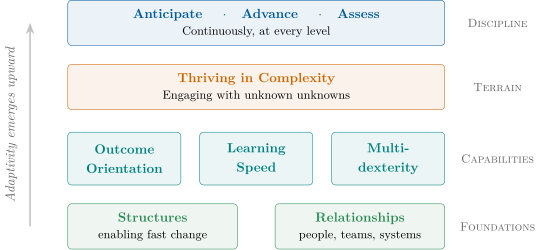
The layers are not a taxonomy to be admired. They are a dependency. The discipline depends on the capabilities. The capabilities can only do their work in the right terrain. And all of it rests on foundations, because if the foundations are missing, the layers above are decoration no matter how well they are worded.
The discipline layer reads like a goal
The top of the definition looks like a goal, and that is the trap. Anticipate, advance, assess reads as a list of good habits, the kind of sentence that belongs on a mission statement. But it is not a list. It is a cycle, and cycles have no first and no last step. An adaptive organisation does not predict the future and then execute against the prediction. It forms a hypothesis, takes a deliberate step, examines the evidence that step produces, and then begins again. The loop does not wait for a quarterly review or an annual planning cycle.
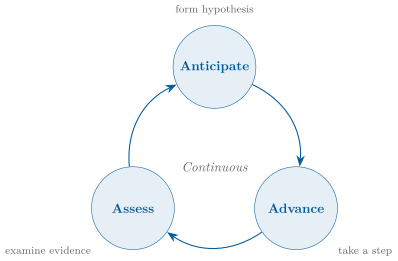
The qualifier at the end, continuously and at every level, is not rhetorical padding. It is the most demanding part of the whole definition, because it names a requirement most organisations fail: the pace of the cycle must hold everywhere in the system, not just in the teams closest to the work. A team can run a cycle in a day while the organisation that funds and directs it runs on a yearly rhythm, and in that gap the whole exercise turns hollow.
The terrain layer picks the battlefield
The second layer does something unusual for a definition. It stops describing the organisation and starts describing the world the organisation must survive in. An adaptive organisation thrives in complexity, engaging with unknown unknowns.
This is a quiet but decisive choice. Complexity is not complication. A complicated problem is difficult but knowable, a machine with many parts that an expert can eventually map. A complex problem is one in which cause and effect can only be understood in retrospect, because the behaviour of the whole emerges from interactions no single person controls. The difference governs which tools work. Planning, executing and controlling suit a complicated world where the map exists in principle. Probing, sensing and responding suit the complex world where the map has to be drawn as you go.
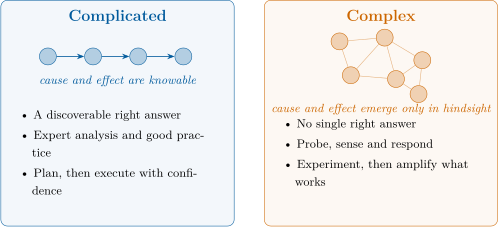
The phrase unknown unknowns is not a flourish. Known unknowns can be insured against, because they have been imagined. Unknown unknowns cannot, because by definition they have not. An organisation designed around predicting the future fails when the future contains events no one predicted. An organisation designed to detect and respond succeeds, not because it is cleverer, but because its structure lets it act on information as it emerges.
The capability layer names three abilities
The third layer is the only one built of three separate parts, and the parts share nothing but the layer they sit in. Each is a capability the organisation must exercise at once.
Organising around outcomes means measuring what changes for the people an organisation serves, not what the organisation delivers. Outputs can be shipped in abundance while nothing improves. Outcomes connect activity to purpose.
Learning faster than the environment evolves sets a relative standard, not an absolute one. The race is not against last quarter’s numbers. It is against the rate at which markets, technologies, regulations and customer expectations are changing around you. de Geus (1997) argued that the only sustainable advantage is the ability to learn faster than the competition; the definition extends that benchmark to the environment itself.
Holding the tension between today and tomorrow is the most uncomfortable of the three, because it refuses the comfort of choosing. An organisation that resolves the tension by choosing today’s operations becomes efficient and risks obsolescence. One that resolves it by choosing tomorrow’s opportunities becomes innovative and risks insolvency. The adaptive organisation does neither. It pursues both at once, with different teams, different metrics and different time horizons, held together by leaders who can sustain the contradiction. March (1991) formalised this as exploration and exploitation; O’Reilly and Tushman (2004) called it ambidexterity; the definition generalises it into multidexterity, adding the middle mode in which a rough idea is made reliable before it is scaled.
The foundation layer is where change actually lives
The lowest layer is the easiest to skip and the most decisive. Two foundations carry everything above them: structures that enable fast change, and healthy relationships between people, teams and the systems that connect them.
Structures here are not the boxes on an organisation chart. They are the design of information flow, of authority and of accountability: who may decide, how quickly, with what access to what is known. A governance process that takes weeks to approve a change is a structural impediment, however well-intentioned. A set of shared principles that guides decisions without demanding approval is a structural enabler.
Relationships are not a pleasant addition to the structure. They are a precondition for it. The most elegant structure in the world fails if the people inside it do not trust one another enough to share information, raise problems and challenge assumptions (Edmondson, 1999). Structures without healthy relationships produce compliance without commitment. Relationships without enabling structures produce goodwill without capability.
The definition sets the two side by side because neither is sufficient on its own. Adaptivity emerges from their interplay.
Leadership holds the architecture together
Notice what the definition never says. It names a discipline, a terrain, three capabilities and two foundations, yet the word leadership never appears. The omission is not an oversight. It is an honest account of how adaptivity arises. The book is explicit from its opening pages: adaptivity is not a feature you can install. It is an emergent property that comes from the interplay of structures, practices, relationships and leadership behaviours. No single one of these produces it, and leadership cannot be bolted on afterwards.
The book treats leadership not as a position but as a continuous practice of sense-making, decision-making and condition-setting, judged by the outcomes it enables rather than the intentions it declares. A leader’s work is to design the conditions in which others can do their best work: clear goals, decision authority close to the work, access to information and trust. This is why the definition can leave leadership out while depending on it absolutely. Every layer above the foundations stays alive only because someone keeps the foundations sound and keeps the discipline honest. A leader who controls execution instead of designing conditions becomes the bottleneck the whole structure has to route around.
Leadership is also what holds the contradiction at the heart of the capability layer. The book is plain about this. Leadership must integrate multidexterity through a practice capable of sustaining the tension, because no structure decides on its own. Someone must protect today’s operations and tomorrow’s opportunities at once, and decide what each receives when they compete. Without that practice, everything above the foundations turns into aspiration that nothing can carry. The cost of failure is steep and fast. A single decision that re-centralises authority can erase years of structural investment, and a leader who believes they have arrived becomes the ceiling on the organisation’s adaptive capacity, because a leader who stops learning signals to everyone that learning is optional.
So leadership is the load-bearing element the diagram leaves out: the vertical practice running from the foundations to the discipline. It is the reason the building can stand at all, and the first place it collapses when neglected. That is the true hidden layer.
The definition reads downwards, but works upwards
Now stand back and look at the shape of the whole. The definition reads naturally from the top, and the top is where it is most quotable. The phrase anticipate, advance and assess sounds like three goals worth striving for, which is exactly how it gets quoted in board papers. But the definition only works from the bottom. Every layer above the foundations is carried by the ones below it.
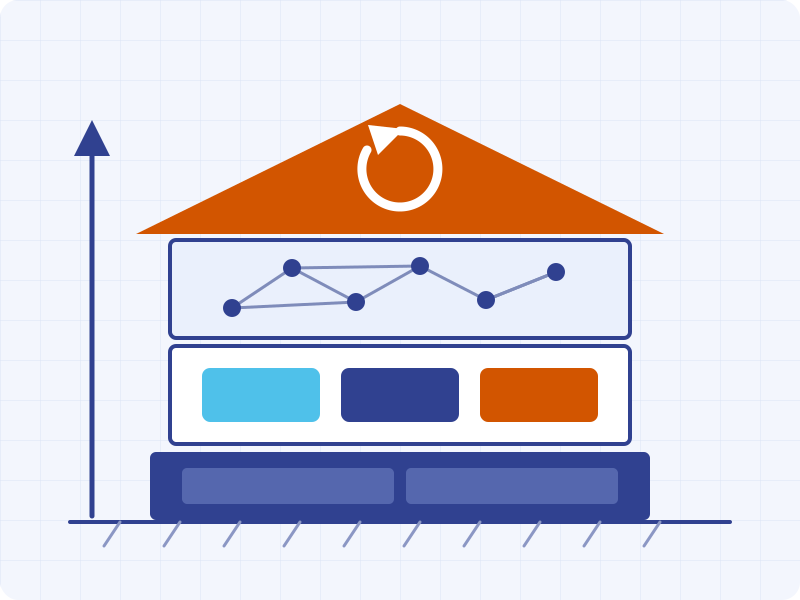
A house explains the point. Downward, the most visible thing is the roof, the part you notice and quote. Yet a roof laid on open ground does not stand. It holds only because the footing, the walls and the beams underneath carry it. The definition is a house whose order is easy to misread. Its most quotable sentence, the discipline at the top, is the roof. Its least visible and most decisive parts, the structures and the relationships at the base, are the footing. Read from the roof down and it is a slogan. Read from the footing up and it is engineering.
The discipline at the top is an effect. The capabilities in the middle are conditions that must be in place for the discipline to be possible. The terrain sets the bounds within which the capabilities matter. And at the base sit the foundations, the actual load-bearing layer, the place where change really happens. The definition lists its effects above its causes, which honestly reflects how organisations present themselves: they love to describe admirable behaviour and prefer not to inspect the foundations.
An example shows the trap at work. An executive team sets anticipate, advance and assess as its stated goals. Read downwards, the sentence sounds like conviction. But the same team sets strategy once a year through a remote hierarchy, gives the people closest to the work no authority to act, and tolerates a climate in which no one contradicts a confident opinion. Read the definition upwards and this organisation fails every check the building depends on. Its discipline is a facade held up by nothing, because the foundations were never poured. The words describe no behaviour that actually happens.
Now the opposite. A team is given real decision authority, a short feedback loop and the trust to report what it learns without blame, and no one bothers to print a slogan about adaptivity. Read upwards, the discipline appears on its own. People form a hypothesis, take a small step, look at what happened and adjust, not because a value statement demands it but because the structure and the relationships make it the obvious way to work. The top layer emerged because the bottom was built. That is the practical difference the order encodes: adaptivity is not proclaimed downwards, it is grown upwards.
That is the whole point of treating the definition as architecture rather than aspiration. The test of whether an organisation understands adaptivity is not whether it can recite the top layer. It is whether it has built the bottom one.
Sources
- de Geus, A. (1997). The Living Company. Harvard Business School Press.
- Edmondson, A. C. (1999). Psychological safety and learning behavior in work teams. Administrative Science Quarterly, 44(2), 350 to 383.
- Society for Adaptive Organisations (2026). Adaptive Organisations: Thriving in Complexity.
- March, J. G. (1991). Exploration and exploitation in organizational learning. Organization Science, 2(1), 71 to 87.
- O’Reilly, C. A., & Tushman, M. L. (2004). The ambidextrous organization. Harvard Business Review, 82(4), 74 to 81.
- Snowden, D. J., & Boone, M. E. (2007). A leader’s framework for decision making. Harvard Business Review, 85(11), 68 to 76.
About this article. This article is a short, adapted summary of one of the core topics of the book Adaptive Organisations: Thriving in Complexity, written and published by the Society for Adaptive Organisations (2026). The full treatment of the subject, together with the supporting argument and reference materials, is developed in the book. Further resources and the book itself are available at adaptive-organisations.org.