Vítejte na stránce s našimi materiály, kde sdílíme postřehy a expertízu v oblasti adaptivity organizací, agility, lean, leadership praktik, digitální transformace a obecně evoluce způsobů práce. Objevte praktické strategie, ověřené přístupy i inovativní metody, které vaší organizaci pomohou uspět v dnešním dynamickém prostředí.
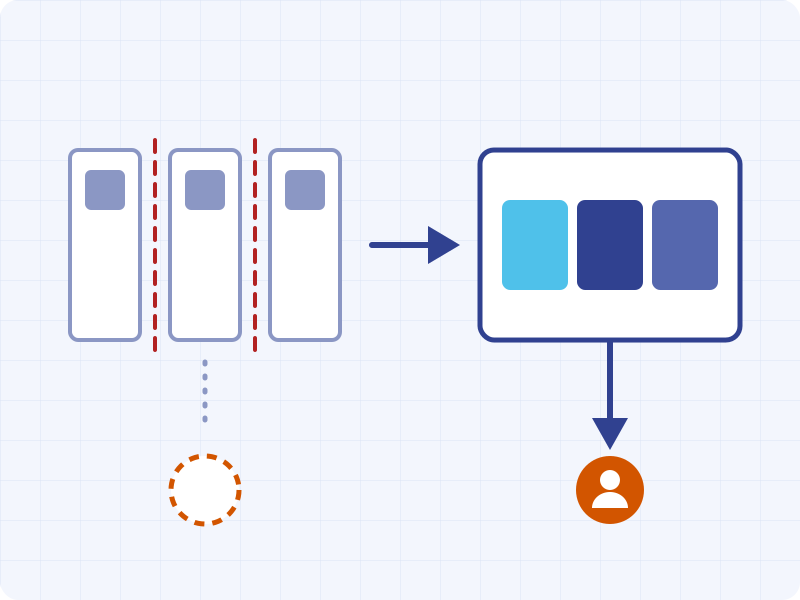
Most organisations are built like a food factory: structured around functions and components, with the customer's result stitched together across the boundaries between them. This first article of the series on the dimensions of adaptivity explains solution orientation, why component teams see no customer, what the shift to solution teams actually costs, and why cutting accidental complexity is a direct lever on speed.
Autor: Society for Adaptive Organisations
Publikováno:
Adaptive OrganisationsDimensions of AdaptivityProduct OrientationTeams
Every clause in the definition of an adaptive organisation is a load-bearing condition, and the only honest response to a specification is to test yourself against it. This second article of the series turns the definition into six checks, scored from one to five, worked from the foundations upwards — with a printable summary sheet and guidance on why the clauses that fail together tell you more than any average.
Autor: Society for Adaptive Organisations
Publikováno:
Adaptive OrganisationsDefinitionSelf-assessmentComplexity & Systems Thinking
The Society's definition of an adaptive organisation is not a slogan but a piece of engineering. Read closely, it is built in four layers — discipline, terrain, capabilities and foundations — each resting on the one below. This first article of the series on the definition shows why the sentence reads downwards but only works upwards, and why leadership is the load-bearing element the diagram leaves out.
Autor: Society for Adaptive Organisations
Publikováno:
Adaptive OrganisationsDefinitionComplexity & Systems ThinkingLeadership & Organisational Development
The organisations that will thrive with AI are not those that adopt the most tools fastest, but those that build the capacity to keep adapting. A more-than-half-century-old law from cybernetics explains why.
Most discussions of adaptive organisations ask the wrong question. Adaptiveness is a snapshot; evolvability — the structural capacity to keep generating useful change — is the film. This piece draws on Ashby's cybernetics, biology's evolvability research, and the AME3 framework to show what that distinction demands in practice.
Most transformation efforts focus on visible change while leaving the deeper logic of the organisation untouched. Sustainable change only becomes possible when organisations can question and redesign the assumptions that shape decision-making itself.
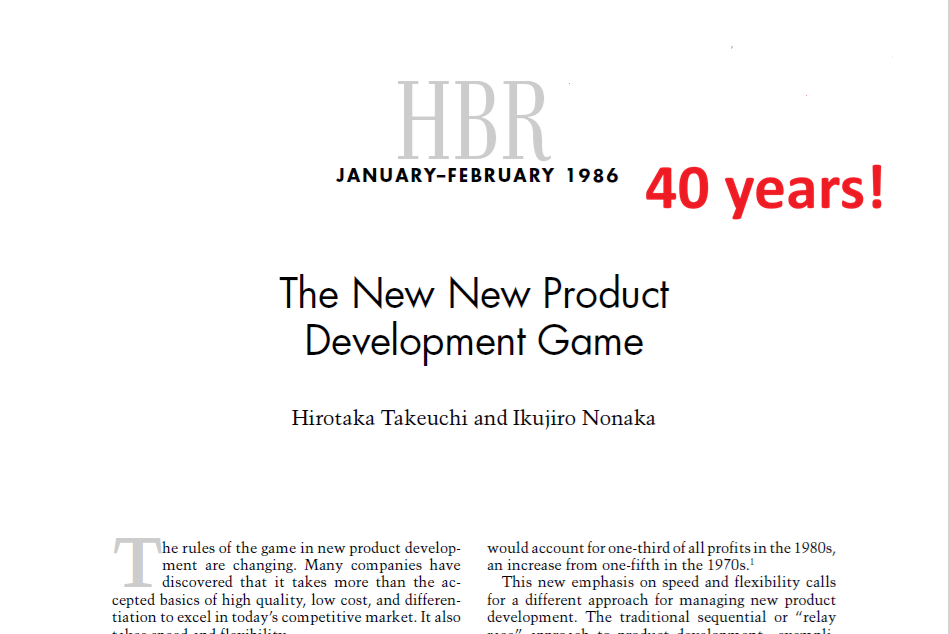
In January 1986, two Japanese professors published an article that would reshape how the world thinks about innovation. Not through a grand theory, but through a rugby metaphor. Hirotaka Takeuchi and Ikujiro Nonaka had spent years studying how the most competitive companies in Japan and the United States actually developed new products. What they found contradicted everything the management world assumed.
An adaptive organisation is defined by its ability to make effective, decentralised decisions, learn continuously, and align today’s actions with future opportunities under conditions of uncertainty. It relies on self-organisation, outcome-focused measurement, and leadership as an ongoing learning practice rather than rigid structures or control. Overall, adaptivity emerges from designing decision-making, collaboration, and learning to navigate complexity and enable continuous change.
Autor: Ilker Demirel
Publikováno:
Adaptive OrganisationsLeadership & Organisational DevelopmentComplexity & Systems Thinking
Organisations today face a paradox: they must deliver value reliably today whilst simultaneously preparing for an uncertain tomorrow. This article explores why sound product management, combined with the structural shift to product orientation, is essential for building truly adaptive organisations. Learn how product management creates coherence, enables fast learning, and provides the strategic discipline needed to thrive in dynamic markets.
Matrix organisation has well-known problems. Combining Back-Front and Modular organisation designs gives you options for creating adaptive organisation, productive teamwork, and market focus.
In times of AI and remote work, the question arises whether traditional teams are becoming obsolete. This article tests Hackman's five conditions for effective teams against dynamic teaming and AI: teams remain relevant, but only under conditions.
Autor: Andreas Schliep
Publikováno:
Adaptive organisationsAgile PrinciplesTeamsAI in Collaboration
This whitepaper examines how organisations can develop genuine adaptability in rapidly changing markets. Traditional functional structures fail when confronted by agile competitors. We identify three essential pillars: product orientation (organising around complete value streams), fast learning cycles (feedback loops measured in days, not quarters), and organisational ambidexterity (exploiting current capabilities whilst exploring new opportunities). Underpinning these is adaptive leadership that enables rather than directs. Organisations that commit to this transformation do not merely survive disruption but create it, generating new markets rather than defending eroding positions.
The article examines the internal and external perspectives on the survivability of organisations. One possible external perspective is reflected in stock market trading data, while one possible internal perspective arises from the knowledge we have about the organisation to which we belong. Four metaphors representing organisations with varying degrees of adaptability provide a good starting point for discussion.